Now that you have a decent setup, the question is how to use it productively and safely. Now that climbing is kinda hitting the big time, there are dozens of would-be gurus peddling wisdom via social media, not to mention the standard names in the training biz. I would trust some more than others based on a few things. Longevity of career, diversity and level of achievement and attitude toward training are the primary attributes to look for. But you can get started on your own, just as they did, and get very good results.
What does that imply for your training? Firstly it implies that you want to understand a few basic principles about training in general and training for climbing more specifically. It also implies that you are willing to follow those principles to logical conclusions and that you are willing to learn from your results. It seems simple but rarely is in practice.
So let's start.
First, the primary principle of strength training is that you must increase load to increase strength. Muscles respond to overload by increasing mass. Tendons thicken. Blood vessels increase. For climbing that load can take a number of forms but on a fingerboard it implies increased weight or increased time under tension. As we shall see, increased time has its problems and will need to be enhanced with increased weight fairly soon. For fingerboard training to be effective, you want to decrease the percentage of potential capacity you have available to use to hang onto a hold. This allows more repetitions at any given level of difficulty starting from maximum load=1 repetition (bouldering) and extending to minimum load=infinite repetitions (easy long routes).
Climbing situations requiring meaningful training tend to fit closer to the lower end of that spectrum on average, meaning you would want to limit numbers of repetitions and focus on increasing loads. This is because most routes feature no more than 15 to 20 consecutive hard (for you) moves before a rest of some sort is needed. This reflects the typical application of energy systems in the body that are used in climbing, i.e. rarely genuinely aerobic and more typically on the anaerobic side. In a nutshell, owing to the small size of human forearm muscles relative to our weight, the need to generate serious force in climbing (in other words, on your project) depends primarily on anaerobic capacity and is rarely sustainable for longer than maybe 2 minutes before some kind of rest is required. Go out and watch climbing videos of even very fit climbers on their hardest routes and typically that is the pattern. Hence the utility of kneebars on step routes!
What does that mean for you? It means you want to be able to generate force well in excess of a hypothetical necessary minimum (your body weight, basically) to stay on a hold. The less force you require out of your hypothetical maximum available strength, the longer you can hang on the hold and/or the more moves you can do on a series of holds that size. It's important that you be prepared to train for different sizes and types of holds and also different grip types, but more on that later.
So starting with the principle of increasing your maximum capacity in terms of static strength seems to me the most plausible foundation for climbing strength overall. I haven't seen anyone discuss where the point of diminishing returns is on this type of strength but I suspect for most of us, it's nowhere near where we could ever aspire to achieve and is therefore irrelevant.
That principle implies that training maximum hanging strength (called max hangs) is a good place to start a training program. It has the advantage of simplicity, easy quantification and builds a strength that is applicable anywhere in the sport of climbing. A few questions arise from this conclusion though. What should I hang off of and how? The answers run roughly along these lines:
What should I hang off of? Something roughly sport-specific is best. For harder climbing that implies flat edges of 1 finger joint in depth (approximately 20-22 mm) or 1/2 joint 12-14 mm) in depth. Most holds fit this description to some degree and the versatility of training offered by those two options is more than enough for most. Pinches, pockets and slopers present complexity, friction-dependency and vulnerability to injuries. For max hangs I would ignore them for now
How should I hang off them? Two topics need to be covered here. One is grip position and the other is duration. Recent consensus is that half-crimp position is most desirable across the board (so to speak) but I would also recommend training open-hand grip as well. Duration? Refer to sport specificity again and you will see that climbers typically stay on a hold between 3 and 6, maybe 7 seconds. Common sense and experience also inform us that real control of a position is not achieved in a mere 2-second effort and going much past 10 seconds is hardly reaching our maximum anymore. So aiming for a 5-7 second hold on a max hang seems appropriate and again that mirrors typical practice and consensus
So now we have basic first principles of hangboarding. Begin with a program of training maximum static strength on a simple flat edge of one finger pad in depth, maybe adding in a half-pad depth edge as well, training two different grip positions as we go. In doing this we lay down a strong foundation for other more complex and sport-specific training exercises, preparing our muscles and connective tissues better for both climbing and training, and gaining maximum productivity out of our limited time.
Next post: putting these first principles into practice
Wednesday, April 29, 2020

Wednesday, April 22, 2020
Next Steps for Training at Home: Equipment Check
So now we're about 5 weeks into the coronavirus lockdown and even if you've been getting out climbing locally and following social distancing guidelines, you might be missing the gym that closed back in March and hopefully you're still supporting by remaining a member. In fact your first impulse might be to build a home wall. Don't. It will probably suck. There are much more efficient ways to train the essentials for hard climbing than a home wall, options that will deliver a much louder bang for the buck.
Basically you need two things. One, that I mentioned before, is the home hangboard. This is the key to maintaining strength and fitness above everything else. If you can't buy a good one, make one from wood that supports half pad and full pad hangs. Pockets, pinches, slopers? Forget it. 7 mm tiny crimps? Unnecessary. Make sure it's sturdy and solid and comfortable because you'll be using it a lot. More on how in the next post.
The other thing that is useful is a home campus board. Three rungs are more than enough, 22cm or so apart. More complex to set up for sure but if you have the space and skills (and the strength) a campus board will deliver the power and lock-off strength that a hangboard can't do so well. Metolius wood rungs remain the standard as far as I am concerned. They also can be used to make a good fingerboard.
What else? In no particular order...
A chalk bucket is super helpful.
Weights. 2 25-pound plates, 2 10s and a 5 will be plenty for most uses. You can use other modes of adding weight but plates threaded on a sling hanging on a harness are the best. Improvise with water bottles or canned food in a pack if you lack proper weights.
An old harness is very useful for adding or removing weight.
Gymnastic rings: many cool strengthening options with these. Try to get wooden ones.
Lashing straps with cam buckles: Use them for the rings or as cheapo TRX-style straps.
7mm static cord: use it for rigging pulley systems and other applications
2 pulleys: use high quality pulleys for taking weight off
Assorted carabiners for clipping things
Weight vests and ankle weights are nice for adding difficulty in a more movement-friendly way
Elastic bands are nice for easy warmups and weight off options
Fans: keep your hanging area as dry and cool as possible
Music: Speakers that can play off your phone are key
Clock: A large movable analog clock with a visible second hand remains superior IMO to phone apps
Floor covering: always good to have something to protect the floor and yourself.
Notebook: record your progress
With these items you can train for just about anything you want. So let's get started!
Basically you need two things. One, that I mentioned before, is the home hangboard. This is the key to maintaining strength and fitness above everything else. If you can't buy a good one, make one from wood that supports half pad and full pad hangs. Pockets, pinches, slopers? Forget it. 7 mm tiny crimps? Unnecessary. Make sure it's sturdy and solid and comfortable because you'll be using it a lot. More on how in the next post.
The other thing that is useful is a home campus board. Three rungs are more than enough, 22cm or so apart. More complex to set up for sure but if you have the space and skills (and the strength) a campus board will deliver the power and lock-off strength that a hangboard can't do so well. Metolius wood rungs remain the standard as far as I am concerned. They also can be used to make a good fingerboard.
What else? In no particular order...
A chalk bucket is super helpful.
Weights. 2 25-pound plates, 2 10s and a 5 will be plenty for most uses. You can use other modes of adding weight but plates threaded on a sling hanging on a harness are the best. Improvise with water bottles or canned food in a pack if you lack proper weights.
An old harness is very useful for adding or removing weight.
Gymnastic rings: many cool strengthening options with these. Try to get wooden ones.
Lashing straps with cam buckles: Use them for the rings or as cheapo TRX-style straps.
7mm static cord: use it for rigging pulley systems and other applications
2 pulleys: use high quality pulleys for taking weight off
Assorted carabiners for clipping things
Weight vests and ankle weights are nice for adding difficulty in a more movement-friendly way
Elastic bands are nice for easy warmups and weight off options
Fans: keep your hanging area as dry and cool as possible
Music: Speakers that can play off your phone are key
Clock: A large movable analog clock with a visible second hand remains superior IMO to phone apps
Floor covering: always good to have something to protect the floor and yourself.
Notebook: record your progress
With these items you can train for just about anything you want. So let's get started!
Saturday, March 28, 2020
First Steps in Training during the Pandemic
In my last post, I cautioned climbers against rushing into training. It's a lot like the way shoppers have been rushing into buying toilet paper. The truth is that training is a bit like toilet paper, there's only so much of it you can use at one time and there's not likely to be a shortage of opportunities to acquire more in the future. I have seen so many posts on social media inquiring about hangboards, how to build climbing walls, what routines to use and so on along with dozens of examples of interactive online workouts, videos, and FAQs. Again the healthy instinct here is to step away from the firehose of information and think clearly about where you are, what you have and what you need. The first step to becoming self-sufficient is understanding these things clearly.
If you're a beginning or truly recreational climber, as I have mentioned before, you don't really need to train anything except climbing, which is unfortunately unavailable for obvious reasons. So don't worry about it. Don't waste time and money on a lousy climbing wall or get bored or frustrated on a hangboard. Go for simple home-based exercises based on the use of your bodyweight and freeweights such as dumbbells. Push-ups are amazing. Running is an excellent option for general fitness especially for those desiring longer objectives outdoors and running with a bit of weight uphill is even better. Put some full water bottles in a pack for the uphill and empty them for the downhill. When the climbing areas or gyms re-open you'll have no problem getting right back into it.
Great video as is all of Dave's content
What kind of hangboard? Buy or make a board that is made of wood and has options for full pad and half pad edges. The other many features that some makers tout are mostly bells and whistles and of very limited utility. Plastic is a material of last resort for hangboards and something I strongly recommend against. I personally own a Beastmaker 2000 and would strongly recommend this company's products. Tension Climbing also makes good hangboards from wood. Metolius campus rungs are another great option as well as this board. Full disclosure: I am not sponsored or supported in any way by these companies.
Another "option" for picking a hangboard is looking at ads in Craigslist. Anything that is still available for sale right now you should firmly socially distance yourself from. Chances are they will be old-school slippery plastic designs that will be neither comfortable nor easy to use. Don't waste your money; purchase (support your local climbing store) or order something that works.
12+ and up? You should include all the above plus a proper climbing wall. This is an investment you should definitely make should you be so lucky as to be employed full-time and have a family, even if there are good climbing gyms close by. If you own your own home and have the free space, this is a great investment in your climbing future. You need never miss a workout for lack of time and you can dial in your equipment to suit your needs and plans, something that even the best gyms don't necessarily provide. Especially important is hold selection, a vital component to any home training plan.
Next post I'll start getting into training specifics but suffice to say, basic is better than elaborate, consistent is better than erratic, and self-awareness beats having to be told what to do. How to get there? We'll get started shortly!
If you're a beginning or truly recreational climber, as I have mentioned before, you don't really need to train anything except climbing, which is unfortunately unavailable for obvious reasons. So don't worry about it. Don't waste time and money on a lousy climbing wall or get bored or frustrated on a hangboard. Go for simple home-based exercises based on the use of your bodyweight and freeweights such as dumbbells. Push-ups are amazing. Running is an excellent option for general fitness especially for those desiring longer objectives outdoors and running with a bit of weight uphill is even better. Put some full water bottles in a pack for the uphill and empty them for the downhill. When the climbing areas or gyms re-open you'll have no problem getting right back into it.
For the more advanced climbers, onsighting easy 5.11 and up to maybe 12a or b, things get complicated. A lot of climbers at this level haven't needed to personally invest in equipment thanks to the proliferation of gyms but consistently use it. Now it's unavailable and options are limited so what to do? As above general fitness is very helpful and worth pursuing but at this level so is sport-specific training. For this level, I would primarily recommend investing in or making a good hangboard. A hangboard will do more, ounce for ounce, than any other training modality. Building a good climbing wall would be awesome but hardly necessary and demands free space, time, tools, and quite a lot of money for materials and holds, along with the judgment to use them all well. I have seen enough pictures of extraordinarily bad climbing walls recently to now consider buying stock in lumber companies. A hangboard is a simple and very effective low-cost option that will definitely help. More on how to use them shortly. If you can't wait there are literal hundreds, if not thousands, of videos out there. This one is probably the best:
Great video as is all of Dave's content
What kind of hangboard? Buy or make a board that is made of wood and has options for full pad and half pad edges. The other many features that some makers tout are mostly bells and whistles and of very limited utility. Plastic is a material of last resort for hangboards and something I strongly recommend against. I personally own a Beastmaker 2000 and would strongly recommend this company's products. Tension Climbing also makes good hangboards from wood. Metolius campus rungs are another great option as well as this board. Full disclosure: I am not sponsored or supported in any way by these companies.
Another "option" for picking a hangboard is looking at ads in Craigslist. Anything that is still available for sale right now you should firmly socially distance yourself from. Chances are they will be old-school slippery plastic designs that will be neither comfortable nor easy to use. Don't waste your money; purchase (support your local climbing store) or order something that works.
12+ and up? You should include all the above plus a proper climbing wall. This is an investment you should definitely make should you be so lucky as to be employed full-time and have a family, even if there are good climbing gyms close by. If you own your own home and have the free space, this is a great investment in your climbing future. You need never miss a workout for lack of time and you can dial in your equipment to suit your needs and plans, something that even the best gyms don't necessarily provide. Especially important is hold selection, a vital component to any home training plan.
Next post I'll start getting into training specifics but suffice to say, basic is better than elaborate, consistent is better than erratic, and self-awareness beats having to be told what to do. How to get there? We'll get started shortly!
Tuesday, March 24, 2020
Training in the Time of Coronavirus Part 1
Hi Everyone,
I want to start by saying that in this rapidly changing environment anything I say should be taken with a grain of premium uncut chalk, maybe two. Your mileage may vary, you may experience technical difficulties, etc.
Okay, now let's begin. Based on my admittedly informal survey of the internet etc, everyone is frantic to train and is busy buying or building the thing/s they think they need to not lose those precious gains they had built up during the winter. This is a normal impulse but not one to be indulged in too heavily. Here's why.
1. At least initially, taking a week or two out around this time of year is something you should probably do anyway. Rest is good for you. Recharging by getting outside just moving around is actually really helpful for your overall climbing ability.
2. You're stressed. The pandemic is a really big deal on multiple fronts and finding the focus and psyche is not going to be automatic, especially if your training options are small, subpar and lonely. So trying to charge in there with ideas of smashing the training plans/goals/whatever are unrealistic. You don't need that additional stress in your life right now, unless that stress is productive.
3. Training is really hard. Climbing is relatively easy. Switching to only training will expose weaknesses you may not have realized you had and injury can result. This is especially true if you haven't been training seriously in the past, which describes a lot of climbers right now.
So what is the first step? Assess what you really need.
Are you climbing 5.10 or lower and just want to climb? Go running or walking while they are still options. Simple bodyweight or free weight exercises are more than enough to keep you climbing fit at that level. A week of climbing when the gyms re-open will do the rest. You're all set. Seriously. Congratulations!
Are you climbing 5.11 or easy 5.12 and don't want to slide? Same as above but maybe add in a bit of fingerboarding. I'll talk more about specifics in another post very soon.
Are you a 12+ to mid-13 climber who wants to keep strong no matter what? Chances are you already have training equipment and some kind of plan. The question is how to leverage that situation to your benefit. Look for that post. Should you build a climbing wall? Yes, you probably should. I'll discuss that too.
13+ and up? You don't need my advice hahaha.
Regardless the way I am going to recommend you train is that it resembles brushing your teeth. You want a sustainable non-crazy routine that will be a habit that can be carried forward regardless of circumstances, one that will enable you to readily jump back on the bus when the doors are opened, whenever that it is. It could be a long time so careful planning now is a great first step.
I want to start by saying that in this rapidly changing environment anything I say should be taken with a grain of premium uncut chalk, maybe two. Your mileage may vary, you may experience technical difficulties, etc.
Okay, now let's begin. Based on my admittedly informal survey of the internet etc, everyone is frantic to train and is busy buying or building the thing/s they think they need to not lose those precious gains they had built up during the winter. This is a normal impulse but not one to be indulged in too heavily. Here's why.
1. At least initially, taking a week or two out around this time of year is something you should probably do anyway. Rest is good for you. Recharging by getting outside just moving around is actually really helpful for your overall climbing ability.
2. You're stressed. The pandemic is a really big deal on multiple fronts and finding the focus and psyche is not going to be automatic, especially if your training options are small, subpar and lonely. So trying to charge in there with ideas of smashing the training plans/goals/whatever are unrealistic. You don't need that additional stress in your life right now, unless that stress is productive.
3. Training is really hard. Climbing is relatively easy. Switching to only training will expose weaknesses you may not have realized you had and injury can result. This is especially true if you haven't been training seriously in the past, which describes a lot of climbers right now.
So what is the first step? Assess what you really need.
Are you climbing 5.10 or lower and just want to climb? Go running or walking while they are still options. Simple bodyweight or free weight exercises are more than enough to keep you climbing fit at that level. A week of climbing when the gyms re-open will do the rest. You're all set. Seriously. Congratulations!
Are you climbing 5.11 or easy 5.12 and don't want to slide? Same as above but maybe add in a bit of fingerboarding. I'll talk more about specifics in another post very soon.
Are you a 12+ to mid-13 climber who wants to keep strong no matter what? Chances are you already have training equipment and some kind of plan. The question is how to leverage that situation to your benefit. Look for that post. Should you build a climbing wall? Yes, you probably should. I'll discuss that too.
13+ and up? You don't need my advice hahaha.
Regardless the way I am going to recommend you train is that it resembles brushing your teeth. You want a sustainable non-crazy routine that will be a habit that can be carried forward regardless of circumstances, one that will enable you to readily jump back on the bus when the doors are opened, whenever that it is. It could be a long time so careful planning now is a great first step.
Friday, March 20, 2020
Training in the Time of Coronavirus: First Impressions
The world has completely changed since I posted last. I wrote about the implications for climbing here at http://www.mountainsandwater.com/2020/03/climbing-hits-wall.html and nothing has changed since then. In fact things are clearly getting much much worse. Closures of public land seem inevitable, or worse yet, complete public lockdowns are in progress which will surely expand beyond the current handful of states. Any naive hopes of turning this crisis into an expanded spring break road trip have been thoroughly quashed by public health closures and repeated posts from climbers on social media and elsewhere saying in essence, "stay home."
 |
| My cellar wall. Yes those are original V10s. Best board shoes ever. Saw a pair on CL recently asking $200.
So what to do? How to do it? Great questions and here are my thoughts this far in.
My first piece of advice is, if you're serious about training, think really long term because this pandemic is going to take a very long time to resolve and when/if it does resolve, things may have changed a lot. So your plan has to be sustainable for weeks and more likely months.
Second piece of advice. Don't make major changes in volume or intensity of anything. Getting injured is really unhelpful and very demotivating. Plus you don't want to see a doctor right now. Seriously, you don't.
Third piece of advice. Don't buy expensive stuff until you absolutely know you need it. Make your own hangboard from scraps of wood. Build the hangboard before you build a home wall.
Fourth piece of advice. Stop stressing about this right now. In fact this might be the worst possible time to launch into a serious training regimen. Take a break. Read some books. Walk the dog. Volunteer to help someone in need. Wait until you have space in your head for actual useful training and then get into it. More on that later.
Fifth piece of advice. Keep your gym membership current. If you can afford it, your local gym needs every dime of revenue you can give. Whether gyms stay open in the future will depend on your support happening right now.
And that's all for now. Later this week or early next, I'll discuss more concrete ideas for maintaining climbing fitness.
|
Saturday, February 22, 2020
That Was Weird
Just before an old set at the BRC came down, I climbed a slew of problems set in a style I am particularly weak at and that had stymied me before. I can't point to any particular aspect of training though I have some ideas, nor was I working on them a whole lot.
The style that I am referring to involves wide pinches and long moves, a popular option in contemporary gym setting, but one that definitely favors certain physiognomies over others. Anyway it was odd to be grabbing said pinches with a whole lot more authority than just previously.
Next post: "Was this the reason?"
The style that I am referring to involves wide pinches and long moves, a popular option in contemporary gym setting, but one that definitely favors certain physiognomies over others. Anyway it was odd to be grabbing said pinches with a whole lot more authority than just previously.
Next post: "Was this the reason?"
Thursday, January 30, 2020
V12? V13? Is it Possible at 55?

Trying the infamously short powerful and classic Powerslave in Red Rock Canyon,a few years back. 2020 is the year to get properly in shape, even at my advanced age. I think it is but it's going to be complex and going forward I will discuss some of the issues involved, many of which I think will be of interest to climbers across the age spectrum but of course older ones.
I think we all want to climb as well as we can for as long as we can. The question is how can we make that happen?
The media available out there for training now is extensive yet complex and sometimes apparently contradictory.
Let's see what we can find!
Sunday, September 25, 2016
Why Wood is Good: Tension Climbing Holds Review
Amidst all the talk about climbing hitting the big time is a topic that few are commenting on, namely the environmental impact of the materials we are using and especially absent is the subject of climbing holds, their manufacture and toxicity and their afterlife. With a new gym popping up every week somewhere and the high use-rate of holds in gyms and resultant wear and tear, increasing numbers of holds are going to wind up, well somewhere. As far as I can tell they are not recyclable so, while they are relatively inert once made and hence not terribly damaging to the environment, they are going to start piling up like used tires, albeit thankfully on a much smaller scale. The toxicity of their manufacture is a whole different level of ick, one that the industry is apparently not anxious to discuss.
Furthermore, honestly, I am growing less and less fond of the feel of plastic holds especially over time as once tacky slopers become slippery gray blobs. Even newer holds overemphasize texture with rough, abrasive surfaces that shred hands and fingers and tear through expensive boot rubber. And the trend towards bigger more volume oriented shapes means even more plastic is being produced and eventually discarded. There has to be a better way, especially for home gyms, training walls and system boards.
Back in the day, climbers made climbing walls with wood with very effective results (see also the short film Splinter) and it's great to see more sophisticated versions of wood holds being marketed. Especially high-quality are the products of Tension Climbing, an outfit here in Colorado with the widest assortment and best looking (and feeling) shapes in this format that I have seen. Photos below are from my wall.

Tension founder Ben Spannuth, who is a friend of mine, dropped off a box of holds to try out which I put up on my home wall. The angles on my wall sit around 35-45 degrees which is perfectly suited to these holds. The finish is perfect, sanded smooth but not polished, with a hand that promises comfortable use even on sore skin. The shapes themselves are ideal for serious training, being neither sharp nor irregular and lending themselves to hard moves and dynamic catches. The shapes would translate well to plastic but the texture is the real bonus with a slightly rough dry feel that no plastic surface could hope to emulate.

I really think it's time that the climbing industry seriously consider the widespread adoption of wood holds. It's a no-brainer for home wall builders to adopt wood as the standard. Wood holds have no toxic off-gassing, can be easily sanded or modified with a non-toxic result (i.e. only sawdust) and if they break or wear out, they can be added to the kindling pile or chipped (remember to pop out the washer!) again with no toxicity and 100% biodegradability. They would work very well with volumes, which themselves should be made of simple non-toxic materials, helping to make the recent fad of gargantuan blobs a lot less harmful to the environment.
Naturally this applies to other training holds such as hangboards and campus rungs. Tension makes excellent campus rungs from wood along with balls and pinches as well as nice-looking hangboard options that deserve a look. Molded hangboards abound on Craigslist and no wonder, they are hard on the skin and joints. Wood should be the standard on hangboards for all the environmental reasons above as well the critical element of providing the best surface for effective high-stress training. Nothing equals it.
I highly recommend checking out the website for a preview of Tension Climbing's products and philosophy. Ben and Will Anglin, Tension's other half and head coach at Earth Treks gym in Golden, are high-end climbers in their own right who take the idea of creating superior training equipment very seriously. I guarantee you will find something you like there. If you want to support high-quality, earth-friendly climbing gear, all made in the USA from sustainable materials, go order some holds. When you do, you know you're doing your part to keep one more last-years-style-neon-pink-blob out of a landfill.
tensionclimbing.com
Furthermore, honestly, I am growing less and less fond of the feel of plastic holds especially over time as once tacky slopers become slippery gray blobs. Even newer holds overemphasize texture with rough, abrasive surfaces that shred hands and fingers and tear through expensive boot rubber. And the trend towards bigger more volume oriented shapes means even more plastic is being produced and eventually discarded. There has to be a better way, especially for home gyms, training walls and system boards.
Back in the day, climbers made climbing walls with wood with very effective results (see also the short film Splinter) and it's great to see more sophisticated versions of wood holds being marketed. Especially high-quality are the products of Tension Climbing, an outfit here in Colorado with the widest assortment and best looking (and feeling) shapes in this format that I have seen. Photos below are from my wall.

Tension founder Ben Spannuth, who is a friend of mine, dropped off a box of holds to try out which I put up on my home wall. The angles on my wall sit around 35-45 degrees which is perfectly suited to these holds. The finish is perfect, sanded smooth but not polished, with a hand that promises comfortable use even on sore skin. The shapes themselves are ideal for serious training, being neither sharp nor irregular and lending themselves to hard moves and dynamic catches. The shapes would translate well to plastic but the texture is the real bonus with a slightly rough dry feel that no plastic surface could hope to emulate.

I really think it's time that the climbing industry seriously consider the widespread adoption of wood holds. It's a no-brainer for home wall builders to adopt wood as the standard. Wood holds have no toxic off-gassing, can be easily sanded or modified with a non-toxic result (i.e. only sawdust) and if they break or wear out, they can be added to the kindling pile or chipped (remember to pop out the washer!) again with no toxicity and 100% biodegradability. They would work very well with volumes, which themselves should be made of simple non-toxic materials, helping to make the recent fad of gargantuan blobs a lot less harmful to the environment.
Naturally this applies to other training holds such as hangboards and campus rungs. Tension makes excellent campus rungs from wood along with balls and pinches as well as nice-looking hangboard options that deserve a look. Molded hangboards abound on Craigslist and no wonder, they are hard on the skin and joints. Wood should be the standard on hangboards for all the environmental reasons above as well the critical element of providing the best surface for effective high-stress training. Nothing equals it.
I highly recommend checking out the website for a preview of Tension Climbing's products and philosophy. Ben and Will Anglin, Tension's other half and head coach at Earth Treks gym in Golden, are high-end climbers in their own right who take the idea of creating superior training equipment very seriously. I guarantee you will find something you like there. If you want to support high-quality, earth-friendly climbing gear, all made in the USA from sustainable materials, go order some holds. When you do, you know you're doing your part to keep one more last-years-style-neon-pink-blob out of a landfill.
tensionclimbing.com
Monday, June 22, 2015
Make or Break by Dave Macleod: A Review

Rating: 5 stars
Summary: Must have book for anyone seriously involved in high-end sport climbing or bouldering, extremely useful for any climber who wants to understand the physiology of climbing injuries
In the recent Bouldering World Cup at Vail, there were four injuries serious enough for competitors to have to pull out of finals, perhaps the most spectacular being Alex Puccio's knee getting hurt in iso. There's a short story on this on 8a.nu. All these climbers were experienced, very strong and as far as I know were professionally coached. Yet they fell prey to the specter of injury. It's unlikely that you have not already suffered something similar or know someone who has within the last year.
Climbing injuries, as in any sport, are a simple fact of life. Rarely do serious climbers go for too long without something turning up and given the increasingly extreme body positions, dynamic movement, and of course ever smaller holds, this tendency is not likely to go away any time soon. Climbing at a high level imply demands a great deal from body parts not intended for that level of stress. So the question is, "How can I manage the risk of injury while still training and working on harder climbs?" And the answer to this is not simple. There are no shortcuts or easy solutions, no wonder salves or miracle devices that will remedy climbing injuries.
 |
| Dave coming off surgery for his ankle |
The master of writing about things in climbing that have no easy solutions is, in my opinion, Dave MacLeod. There is no better writer in English on the subject of getting better in climbing, and I cannot think of any with a better track record on hard routes of every type, including hard bouldering. In his book, 9 Out of 10 Climbers Make the Same Mistakes, he delivered a clear message that if you want to get better you need to take a clear, objective look at what you are doing wrong. This could mean some fairly harsh self-appraisal in the process.
In his new book Make or Break: Don't Let Climbing Injuries Dictate Your Success, he takes a similar tack, encouraging climbers to look at all the dimensions of injury, especially climbing and training practices and attitudes that increase the chances of injury. He writes, "Even though injuries often seem to be an accidental misfortune it is likely that the causes are are things under your control. You just didn't know it."
Finding the balance between healthy productive training and climbing and injury-provoking unproductive training and climbing has long been the holy grail of serious climbers. The internet and social media has complicated this quest by dumping dozens of possible approaches, many of them without context or explanation and often in the form of "training" videos that showcase the abilities of marquee climbers to do one-arm campus boarding or one-finger front levers or whatever. Training for climbing however is a much more complicated process than imitating the achievements of the famous. A World Cup champion told me recently that the things he did in one of these videos were the result of years of careful training and preparation and certainly not to be imitated without a similar period of training.
Climbing in particular is, as MacLeod puts it, at an "embryonic stage" when it comes to understanding its biomechanical principles. Only recently, for example, have researchers begun to understand the physiology of tendon overuse injuries. Figuring out the best ways to productively stress body tissue and perhaps more importantly, productively recover from these stresses is still in an incipient state. The media reports breathlessly about the latest greatest sends and sponsors are eager to tout their athletes' strength and achievements. Sometimes it seems like all we have to do is go "a muerte" and miracles will happen. MacLeod reminds us that more likely than not, the bill will come due sooner or later, regardless of age or skill level, unless we correctly manage the stresses of training and climbing.
For MacLeod, the key elements for injury prevention are self-knowledge combined with a constant vigilance for bad technique and an awareness of the most likely scenarios for injury. Managing expectations for training and climbing is a critical component for navigating the path between productive and injurious stress. Awareness of good body, limb, and hand positions as opposed to mechanically disadvantageous ones is critical to learning the most efficient movement pathways. Often overlooked are tactical strategies. Shoe fit, chalk, impromptu competitions, climbing when tired, all can play a role in setting up the conditions for a serious injury. Finally adequate attention needs to be paid to posture and resting. As Macleod writes, "Amateurs are essentially trying to lead a double life, one with family and work commitments and another of training." Multiple non-athletic stresses can add up to poor physical and psychological recovery, chief among which is lack of sleep. Lack of mental clarity and focus can cause significant issues while training and climbing.
But what if you do get injured? What then? How can you recover effectively and as quickly as possible. Again Macleod's advice is realistic, accurate and well founded in personal experience, not mention a copious amount of reading in scientific and medical journals. Climbers are notorious for seeking out quick fixes for injuries and MacLeod discusses many of the more popular modes of therapy but with the cautionary note that "there is a gross lack of hard scientific research evidence for their effectiveness in achieveing long term recovery from soft tissue injuries." A similarly skeptical and conservative approach to drugs and surgery is expressed which is certainly to a climber's benefit owing to uncertain (except in obvious cases) benefit and problematic side effects. It's clear that the only effective approach to treatment is serious research and conversation with peers and medical professionals, the latter an especially dismal task in America given our haphazard and expensive medical "system."
A couple of effective and short chapters on the psychological dimension of injuries and special issue relating to youth climbers follows. The latter is an increasingly important aspect of climbing training, not least because relatively few youth coaches have any serious background in sport science at this point. I recommend this chapter especially to youth coaches and would be surprised if a proper text on youth climbing coaching doesn't appear soon. There is a real need for it.
The remainder of the book focuses on specific physical aspects of climbing injuries looking at typical problem spots such as elbows, shoulders, fingers and lower body areas, the latter being of particular interest to boulderers. Injuries to ankles and knees from impact upon landing are a serious problem. These chapters are invaluable reference points for climbers having to deal with the classic issues of elbow pain and finger pulley tears. Again MacLeod is not preenting magic cures or secret tricks, just thorough complete discussion of what we know and can do about these injuries.
I would unhesitatingly recommend this book both to climbers and health care workers interested in treating climbers. It is the best single authoritative resource in English on the subject from a climber with extensive personal experiences with injury (recounted in the back of the book) and experience at the top of the sport across multiple disciplines. It's not an inexpensive book but if it saves you the expense in terms of time, effort and hard cash that an injury can involve, it is well worth it.
http://davemacleod.com/shop/makeorbreak.html (Signed copies from Dave's shop)
http://www.amazon.com/Make-Break-Climbing-Injuries-Dictate/dp/0956428134
Thursday, March 19, 2015
Bouldering and its Physical Impacts: What Should We Know?
Climbing has reached new heights of visibility so to speak with the widespread media coverage of the Dawn Wall ascent earlier this year, an ascent where the strengths and skills developed through high-level bouldering played a major part (to be discussed in another post). In this country at least bouldering as a competition discipline appears to be much more popular than roped climbing and clearly a favorite for youth team training. In other words the future trajectory for bouldering participation appears to be on an upward trend (haha), which is a good thing.
Along with this popularity, however, there is going to have be a serious discussion of how gyms, youth coaches and the industry in general will mitigate the physical impact of bouldering going forward. This is a topic that is gaining increasing traction in youth football right now and there is considerable concern that parents will be reluctant to allow their children to play football for fear that irreversible brain damage could be a result of hard hits on the playing field. It has been suggested by Dave MacLeod in his new book Make or Break, that repeated impacts on young climbers could affect vulnerable growth plates, just as with finger overuse injuries, stunting the growth of the lower limbs.
It has long been noted that in bouldering, "Every fall is a ground fall" and the (under-reported) fact is that a fair number of old-school boulderers are paying a significant price for the harder falls of the pre-pad generation. John Sherman, author of the "other" book on bouldering, was taken to the hospital by myself and a friend after popping off a lowball traverse and bouncing his head on a slab at the base. This was one of several concussions he sustained. He has also had two hip transplants. I had a similar experience a couple of years ago in RMNP, ironically bouncing off a pad and winding up with six staples in my scalp.
It is a concern of mine that we are not anticipating carefully enough the long-term consequences of bouldering falls, not merely hard impacts as mentioned above but also the less-obvious impacts of repeated "safe" falls, especially in the gym. While I don't think they present the kind of threat posed by the collisions of tackle football, I also am not seeing any clear effort made by the climbing industry to fund scientific research on landing materials, landing configuration, wall construction, route setting and of course fall training as it relates to indoor climbing. This is critical because although outdoor falls present the apparently more dangerous outcomes, most falls occur in the confines of a gym where the convenience and apparent safety of a wall allow multiple repeated falls in a short span of time.
As a long-time boulderer myself, I have become increasingly aware of problematic trends in bouldering wall design that have the potential side-effects of promoting long-term chronic injury for their users. The first and foremost of these is height. Despite the glamorization of so-called highball bouldering in climbing media, there are certain basic laws of physics at work that cannot be ignored regarding mass acceleration and the impact forces that result. In a nutshell, the longer the fall the more intense the forces that must be absorbed upon impact.
These forces multiply very rapidly so that a fall of two meters has half the impact of a four meter fall, basically a doubling of impact force created by a negligible amount of additional vertical rise in climbing terms. You can check this out thanks to the Splat Calculator, a page posted by a climber. What this implies for a boulderer is that a common gym design, that is a steep lower wall followed by an upper more slabby portion, is tacking on vertical gain in such a way as to make that upper portion much more dangerous in the event of a fall. This danger can be augmented even further by a problem set with a crux move near or at the end, raising the chances for a fall and even worse an out-of-control fall.
It's my view that bouldering gyms are now making walls that are much too high. Tall walls look better in photos and create an initial perception of adding value to the visitor's experience but for regular users may have the opposite effect, raising the chances for catastrophic acute injury and inevitably, and unnecessarily adding to the cumulative impacts of repeat falls and deliberate dismounts from the wall (as when a climber is forced to drop from the top). Ironically tall walls inhibit effective training for this reason as the climber pays a real physical cost for repeated impact in exchange for uncertain training benefit, especially with movement that is all too often affected by awareness of the wall height and the potential impact of a fall.
I hear from route setters and others that actually these walls aren't that high, remarks that are often tinged with a hint of young male bravado, implying that my concerns are a byproduct of timidity or cowardice. However, I have seen too many young climbers quit the sport for various reasons, especially injury, and have heard from too many older climbers who are intimidated precisely by the potential real-life consequences of an injurious fall to take these responses seriously. Regardless of one's reserves of courage, the laws of physics are strictly enforced in the event of a fall and it seems incumbent on gyms to maximize the well-being of their customers over the ego of the setters and wall designers.
Another issue is the landing surface and its configuration. While there are commonalities with gymnastics there are also significant differences as well, especially regarding the height and irregularity of the falls, not to mention the skill level of the athlete and lack of spotting. Basically bouldering gym flooring is in a state of infancy regarding its materials and how it is set up. Gyms want a surface that is safe and durable, two qualities that do not always coincide.
So what is to be done? Obviously the first option is the status quo which so far is building high walls and hoping for the best. In my view to do this is missing a great opportunity to seriously study the costs and benefits of different bouldering setups to find the one that best maximizes climbing potential and minimizes risk of injury, whether acute or chronic. The industry is currently on a binge of wall construction which provides a great laboratory for next generation walls and landings to build upon.
If you are a frequent boulderer and want to stay healthy, focus your training time on low-impact high difficulty problems that won't cause repeated high-impact falls. If you are motivated to work a particularly high problem, a good tactic to use inside is climbing up on big holds to establish on a high crux in a less tired state, so you learn the move quicker and are less likely to take repeated falls. Avoid gratuitously dangerous high moves such as big sideways dynos as they have a tendency to wreck shoulders and pitch climbers upside down. Outside, if feasible, working a highball on toprope is a really good idea to spare your ankles, knees, hips and back the repeated stress of landing. It goes without saying to pad things as well as possible. Lastly, inside or out, learn how to fall correctly, dissipating impact forces by rolling away from the landing whenever possible. Always analyse in advance the most likely places to fall and anticipate your possible body position in flight and at impact. A competent spotter can be a big help in limiting these forces as well. Good luck and safe bouldering!
Along with this popularity, however, there is going to have be a serious discussion of how gyms, youth coaches and the industry in general will mitigate the physical impact of bouldering going forward. This is a topic that is gaining increasing traction in youth football right now and there is considerable concern that parents will be reluctant to allow their children to play football for fear that irreversible brain damage could be a result of hard hits on the playing field. It has been suggested by Dave MacLeod in his new book Make or Break, that repeated impacts on young climbers could affect vulnerable growth plates, just as with finger overuse injuries, stunting the growth of the lower limbs.
It has long been noted that in bouldering, "Every fall is a ground fall" and the (under-reported) fact is that a fair number of old-school boulderers are paying a significant price for the harder falls of the pre-pad generation. John Sherman, author of the "other" book on bouldering, was taken to the hospital by myself and a friend after popping off a lowball traverse and bouncing his head on a slab at the base. This was one of several concussions he sustained. He has also had two hip transplants. I had a similar experience a couple of years ago in RMNP, ironically bouncing off a pad and winding up with six staples in my scalp.
It is a concern of mine that we are not anticipating carefully enough the long-term consequences of bouldering falls, not merely hard impacts as mentioned above but also the less-obvious impacts of repeated "safe" falls, especially in the gym. While I don't think they present the kind of threat posed by the collisions of tackle football, I also am not seeing any clear effort made by the climbing industry to fund scientific research on landing materials, landing configuration, wall construction, route setting and of course fall training as it relates to indoor climbing. This is critical because although outdoor falls present the apparently more dangerous outcomes, most falls occur in the confines of a gym where the convenience and apparent safety of a wall allow multiple repeated falls in a short span of time.
As a long-time boulderer myself, I have become increasingly aware of problematic trends in bouldering wall design that have the potential side-effects of promoting long-term chronic injury for their users. The first and foremost of these is height. Despite the glamorization of so-called highball bouldering in climbing media, there are certain basic laws of physics at work that cannot be ignored regarding mass acceleration and the impact forces that result. In a nutshell, the longer the fall the more intense the forces that must be absorbed upon impact.
These forces multiply very rapidly so that a fall of two meters has half the impact of a four meter fall, basically a doubling of impact force created by a negligible amount of additional vertical rise in climbing terms. You can check this out thanks to the Splat Calculator, a page posted by a climber. What this implies for a boulderer is that a common gym design, that is a steep lower wall followed by an upper more slabby portion, is tacking on vertical gain in such a way as to make that upper portion much more dangerous in the event of a fall. This danger can be augmented even further by a problem set with a crux move near or at the end, raising the chances for a fall and even worse an out-of-control fall.
It's my view that bouldering gyms are now making walls that are much too high. Tall walls look better in photos and create an initial perception of adding value to the visitor's experience but for regular users may have the opposite effect, raising the chances for catastrophic acute injury and inevitably, and unnecessarily adding to the cumulative impacts of repeat falls and deliberate dismounts from the wall (as when a climber is forced to drop from the top). Ironically tall walls inhibit effective training for this reason as the climber pays a real physical cost for repeated impact in exchange for uncertain training benefit, especially with movement that is all too often affected by awareness of the wall height and the potential impact of a fall.
I hear from route setters and others that actually these walls aren't that high, remarks that are often tinged with a hint of young male bravado, implying that my concerns are a byproduct of timidity or cowardice. However, I have seen too many young climbers quit the sport for various reasons, especially injury, and have heard from too many older climbers who are intimidated precisely by the potential real-life consequences of an injurious fall to take these responses seriously. Regardless of one's reserves of courage, the laws of physics are strictly enforced in the event of a fall and it seems incumbent on gyms to maximize the well-being of their customers over the ego of the setters and wall designers.
Another issue is the landing surface and its configuration. While there are commonalities with gymnastics there are also significant differences as well, especially regarding the height and irregularity of the falls, not to mention the skill level of the athlete and lack of spotting. Basically bouldering gym flooring is in a state of infancy regarding its materials and how it is set up. Gyms want a surface that is safe and durable, two qualities that do not always coincide.
So what is to be done? Obviously the first option is the status quo which so far is building high walls and hoping for the best. In my view to do this is missing a great opportunity to seriously study the costs and benefits of different bouldering setups to find the one that best maximizes climbing potential and minimizes risk of injury, whether acute or chronic. The industry is currently on a binge of wall construction which provides a great laboratory for next generation walls and landings to build upon.
If you are a frequent boulderer and want to stay healthy, focus your training time on low-impact high difficulty problems that won't cause repeated high-impact falls. If you are motivated to work a particularly high problem, a good tactic to use inside is climbing up on big holds to establish on a high crux in a less tired state, so you learn the move quicker and are less likely to take repeated falls. Avoid gratuitously dangerous high moves such as big sideways dynos as they have a tendency to wreck shoulders and pitch climbers upside down. Outside, if feasible, working a highball on toprope is a really good idea to spare your ankles, knees, hips and back the repeated stress of landing. It goes without saying to pad things as well as possible. Lastly, inside or out, learn how to fall correctly, dissipating impact forces by rolling away from the landing whenever possible. Always analyse in advance the most likely places to fall and anticipate your possible body position in flight and at impact. A competent spotter can be a big help in limiting these forces as well. Good luck and safe bouldering!
Sunday, October 12, 2014
Friction Labs Chalk Review
Friction Labs Chalk Review
For bouldering, there are three essential tools: shoes, chalk and pads. Of these three, shoes probably get the most attention which makes a certain degree of sense. But the fact is that most of us really have no clue about the nature of the stuff we put on our hands to keep them dry. I have been increasingly frustrated with the chalk manufactured and sold by the bigger names in the industry, noticing that its texture and drying power seemed "off" somehow. I was also concerned about the nature of the "drying agents" and the lack of transparency in regard to the actual ingredients involved. Some of this I addressed a few years back in a post called "The Chalk Review"
Since then some better chalks have emerged including that branded and sold by Mammut which I have used successfully in the past. However the most interesting development is an entirely new company, based in Colorado, called Friction Labs which has basically taken the approach of creating and selling via mail-order pure pharmaceutical grade chalk designed specifically for different kinds of climbing situations.
Kevin at FL was kind enough to send some samples my way that I had the opportunity to try out over the past few months, mostly in RMNP and the gym. There are three varieties of texture called Bam Bam, Gorilla Grip, and Unicorn Dust. Across the board, I was struck immediately by the excellent "hand" of the different chalks, what I would describe as a dry and slightly tacky feel when your fingers rub together. This tended to remain the case when actually gripping holds even the slippery and conditions-dependent gneiss of Lower Chaos Canyon. Kevin at Friction Labs explained that the key is the high percentage of magnesium carbonate which acts to trap moisture inside the chalk. Other chalks contain larger amounts of calcium carbonate which lacks this absorbent capacity, not to mention other unspecified filler materials. I recommend you read the chemical analysis posted at the FL website, something that to my knowledge no other company has done previously.
Personally I preferred the chunkier harder texture of the Bam Bam variety but I recommend you try out each of the different textures to see which suits your skin and climbing style the best. The only caveat is the price as it is much more expensive than other climbing chalks. However the subscription plan price includes free shipping and handling, an arrangement which is a real plus in making sure you always have the good stuff at hand, so to speak. Otherwise if you are left at the mercy of the local climbing shop's stock, you may be stuck with one of the "other" chalks, something that I have found makes a real difference, especially if you are working problems right at your limit.
For serious climbers, I think this is a great development and a chance to help a small start-up providing a very high quality product and service at a reasonable price. If you are looking for an extra tool for getting better results from your valuable climbing time, I strongly recommend checking them out.
 |
| The logo for Friction Labs Unicorn Dust |
For bouldering, there are three essential tools: shoes, chalk and pads. Of these three, shoes probably get the most attention which makes a certain degree of sense. But the fact is that most of us really have no clue about the nature of the stuff we put on our hands to keep them dry. I have been increasingly frustrated with the chalk manufactured and sold by the bigger names in the industry, noticing that its texture and drying power seemed "off" somehow. I was also concerned about the nature of the "drying agents" and the lack of transparency in regard to the actual ingredients involved. Some of this I addressed a few years back in a post called "The Chalk Review"
Since then some better chalks have emerged including that branded and sold by Mammut which I have used successfully in the past. However the most interesting development is an entirely new company, based in Colorado, called Friction Labs which has basically taken the approach of creating and selling via mail-order pure pharmaceutical grade chalk designed specifically for different kinds of climbing situations.
Kevin at FL was kind enough to send some samples my way that I had the opportunity to try out over the past few months, mostly in RMNP and the gym. There are three varieties of texture called Bam Bam, Gorilla Grip, and Unicorn Dust. Across the board, I was struck immediately by the excellent "hand" of the different chalks, what I would describe as a dry and slightly tacky feel when your fingers rub together. This tended to remain the case when actually gripping holds even the slippery and conditions-dependent gneiss of Lower Chaos Canyon. Kevin at Friction Labs explained that the key is the high percentage of magnesium carbonate which acts to trap moisture inside the chalk. Other chalks contain larger amounts of calcium carbonate which lacks this absorbent capacity, not to mention other unspecified filler materials. I recommend you read the chemical analysis posted at the FL website, something that to my knowledge no other company has done previously.
Personally I preferred the chunkier harder texture of the Bam Bam variety but I recommend you try out each of the different textures to see which suits your skin and climbing style the best. The only caveat is the price as it is much more expensive than other climbing chalks. However the subscription plan price includes free shipping and handling, an arrangement which is a real plus in making sure you always have the good stuff at hand, so to speak. Otherwise if you are left at the mercy of the local climbing shop's stock, you may be stuck with one of the "other" chalks, something that I have found makes a real difference, especially if you are working problems right at your limit.
For serious climbers, I think this is a great development and a chance to help a small start-up providing a very high quality product and service at a reasonable price. If you are looking for an extra tool for getting better results from your valuable climbing time, I strongly recommend checking them out.
Tuesday, August 5, 2014
The Rock Climber’s Training Manual: A Boulderers Perspective
 |
| Images from the cover and contents of The Rock Climber's Training Manual |
Over the past decade, Mark and Mike Anderson, brothers with
a lengthy and substantial climbing record across disciplines, have been
developing a training protocol called the Rock Prodigy Training Method. It’s
clearly having results. For example, Mark has emerged as a very strong climber, repeating various testpieces here in Colorado and in Utah and Oregon, as well
as doing 5.14 first ascents in places like Clear Creek Canyon and Shelf Road.
When their book The Rock Climber’s
Training Manual (referred to from here on out as TRCTM) came out I was very
interested to see what they would come up with. As a climbing book author
myself, I understand all too well the challenges inherent in gathering and
presenting what can be at times a very complex subject.
Fixed Pin Publishing very kindly sent me a copy of tTRCTM for review and I was immediately impressed by the richness and finish of the
book. The writing is very clear and the organization logical and coherent. The
basic premise of the book is that climbing improvement is a quantifiable
process and that a climber who wants to improve has to base that process on a
predictable plan with measurable goals and benchmarks. I think on this level
alone the book is very successful.
TRCTM is primarily intended for mid-level to advanced sport
climbers, an audience that is more likely to be interested in the kinds of
progression outlined in its pages. This is both its strength and weakness, at
least as far as bouldering is concerned. The front cover and indeed many of the
illustrations throughout the book are from the Red River Gorge and Smith Rock,
areas that emphasize continuous endurance climbing and in the case of many
routes in Smith, relatively low-angle technical small hold climbing. The Smith
Rock photos especially give the book a bit of a retro feel, since the
progression in high-end sport and bouldering in America has been on relatively steep power-endurance
routes such as at Rifle or problems like those found in RMNP or Hueco Tanks.
The gist of TRCTM is that following periodized cycles of
training will result in the greatest gains for your climbing, something that
has been at the heart of most training books in English since the
groundbreaking (and surprisingly current) Performance Rock Climbing by Dale
Goddard and Udo Neumann was published back in the 90s. Establishing levels of
strength, power and power endurance by means of the hangboard and campus board
along with regular trips to the gym are the heart of this training program.
Reviewing the basic outline of the training programs in the book, I found the
workout plans and tactics made sense, although I found the means by which one
finds the optimal weight at which to train on a fingerboard not entirely easy
to understand. I am terrible with charts and graphs, though. Everything is presented
in a relatively logical and analytical fashion and this is reassuring to anyone
embarking on a training plan. It’s a solid and comprehensive guide to getting
better, no question, especially for sport climbing.
For the specific pursuit of bouldering however I think this
book could stand some revision. Among other things I found curious was the
proposition that hangdogging and refining beta while working routes was easier and
more typical than in working boulder problems because the boulderer climbs from
the ground. In actuality boulderers often work problems close to the ground
with sit starts or steep features that allow stepping into crux moves or
sections quite easily. Boulderers are obsessive with refining beta to a degree
that might astonish some sport climbers unfamiliar with this aspect of the
sport. A closer look at the practices at the leading edge of bouldering today
would help iron out some of these issues.
In terms of training, bouldering is not just about adding
more intensity or weight, it is also about mastering very different body
positions, learning types of dynamic movement, coping with mental pressures, and developing effective tactics for safe successful attempts on problems, all in ways that will differ drastically from an enduro route in
the Red. Boulderers need to closely understand complex heelhooking, kneebars,
toehooks, and the overall intricacies of compression climbing. Dynamic movement,
though key in bouldering, is given relatively small space in the text as a
whole and not much in the (very short) section dedicated to bouldering. Of
course in bouldering dynamic climbing is critical to success on any limit
problem. The mental pressures of working out multiple limit moves that must be
linked flawlessly are similar to sport climbing but take on a qualitatively
different intensity in bouldering where success and failure can occur almost
arbitrarily. In other words, if training for climbing can be described as a
science, as TRCTM clearly intends, bouldering still feels more like an art where
criteria for advancement seem qualitative and subjective.
Is TRCTM desirable for boulderers? Yes and no. Given the
relatively short space dedicated to the sport in the book, it is clear that it’s
not primarily intended for bouldering, though ironically bouldering is seen as
critical in providing power for improving one’s sport-climbing level. However,
for any climber looking for a current and comprehensive understanding of the
basics of training theory as it applies to climbing overall, TRCTM is a great and relatively
inexpensive place to start. The effort and diligence of the authors is apparent
throughout and the publisher’s care in terms of layout and production is
clearly evident. But for bouldering training specifically, it has significant
limitations. The book on bouldering training hasn’t been written though I have been working on it a
bit. Watch this space.
Find out more at http://rockclimberstrainingmanual.com/
Mark's excellent blog https://lazyhclimbingclub.wordpress.com/
Tuesday, February 5, 2013
The Myths of the Fingerboard 2
In my previous post I discussed why I think that most commercially produced boards are not the best investments. In this post, which is related to a much earlier post, I want to discuss why fingerboard training may not be the most effective use of your training time.
As I mentioned before, there seems to be a lot of interest in fingerboards right now. There isn't a training forum out there that isn't visited weekly with posts about whether fingerboards will help and how to use them and so on. Every post pretty much asks the same thing: will a fingerboard make me stronger? The truth is simple; it depends. Here is my view about some common beliefs about fingerboards.
First myth: Fingerboards are essential for making a step up the grades. For the climber operating much below V5 or mid-5.12, fingerboards really have no place in your climbing training unless you are stuck for time and don't have access to a climbing wall. At that level, the use of a fingerboard is a waste of time better spent getting stronger actually climbing and understanding what climbing harder is actually about. It's about moving well, using your feet, and keeping your focus when the going gets tough. Fingerboards do not train those skills. If you ask around, the vast majority of top-end boulderers spend next to no time on a fingerboard. They climb instead.
Second myth: Fingerboards should be a constant part of your training plan. I would recommend phases of fingerboarding, no more than two or three times a week for no longer than a few weeks in duration with a month or two break in between. The potential for getting stale and worse, injured, is too high considering the limited benefits. Use the board to kickstart your next power training phase and then set it aside for a while and train while climbing.
Third myth: Fingerboards make you a stronger climber. The ability to climb hard, in my view, is not merely catching a hold and hanging on, but instead is reflected in how far you can lock off to the next hold with the last hand well below you. Independence of both arms when moving on steep terrain is what it's all about. Fingerboards will not necessarily help this kind of strength as hanging on with two hands is much easier than with one, and hanging with one is infinitely easier than pulling up on one hand on an edge.
Fourth myth: you can train power on a fingerboard. Power is work produced in a given unit of time. If you can generate maximum force in half a second instead of two, you are using more power to do that and that is very helpful in doing hard moves. Power is everything in hard bouldering but it is very hard to generate power effectively on a fingerboard. Everything points to the campus board for that but as with the fingerboard, it's not that simple. Again, maybe in another post.
Fifth myth: Hanging on smaller holds equals a stronger climber. See myth 3. Hanging with two hands off a super thin edge is of minimal use because most problems don't require that kind of hold. More typical is the scenario mentioned above, a long pull from one decent-sized hold to another, repeated 6 to 10 times. That said, many commercial hangboards feature holds that are simply too big to be much use for the serious climber.
Sixth myth: Adding weight is a constructive way to increase resistance. See myth 3 again. Hanging on with two hands is too easy, even with weight on. It's much more constructive to work on your one-handed ability than to add 50 or 75 pounds and get meager gains.
Seventh myth: While I'm hanging, I might as well do some pull-ups. Sure, if they are one-arms. Otherwise, you are just training endurance hanging on with two hands which happens in bouldering, well, basically never.
So what are fingerboards good for? I like them for waking up my fingers on a regular basis in getting a power phase started but really only for a short time before moving on to campusing and then real climbing. And then there is the problem of effective pinch strength development. Again, these training tactics might be better handled in a later post
As I mentioned before, there seems to be a lot of interest in fingerboards right now. There isn't a training forum out there that isn't visited weekly with posts about whether fingerboards will help and how to use them and so on. Every post pretty much asks the same thing: will a fingerboard make me stronger? The truth is simple; it depends. Here is my view about some common beliefs about fingerboards.
First myth: Fingerboards are essential for making a step up the grades. For the climber operating much below V5 or mid-5.12, fingerboards really have no place in your climbing training unless you are stuck for time and don't have access to a climbing wall. At that level, the use of a fingerboard is a waste of time better spent getting stronger actually climbing and understanding what climbing harder is actually about. It's about moving well, using your feet, and keeping your focus when the going gets tough. Fingerboards do not train those skills. If you ask around, the vast majority of top-end boulderers spend next to no time on a fingerboard. They climb instead.
Second myth: Fingerboards should be a constant part of your training plan. I would recommend phases of fingerboarding, no more than two or three times a week for no longer than a few weeks in duration with a month or two break in between. The potential for getting stale and worse, injured, is too high considering the limited benefits. Use the board to kickstart your next power training phase and then set it aside for a while and train while climbing.
Third myth: Fingerboards make you a stronger climber. The ability to climb hard, in my view, is not merely catching a hold and hanging on, but instead is reflected in how far you can lock off to the next hold with the last hand well below you. Independence of both arms when moving on steep terrain is what it's all about. Fingerboards will not necessarily help this kind of strength as hanging on with two hands is much easier than with one, and hanging with one is infinitely easier than pulling up on one hand on an edge.
Fourth myth: you can train power on a fingerboard. Power is work produced in a given unit of time. If you can generate maximum force in half a second instead of two, you are using more power to do that and that is very helpful in doing hard moves. Power is everything in hard bouldering but it is very hard to generate power effectively on a fingerboard. Everything points to the campus board for that but as with the fingerboard, it's not that simple. Again, maybe in another post.
Fifth myth: Hanging on smaller holds equals a stronger climber. See myth 3. Hanging with two hands off a super thin edge is of minimal use because most problems don't require that kind of hold. More typical is the scenario mentioned above, a long pull from one decent-sized hold to another, repeated 6 to 10 times. That said, many commercial hangboards feature holds that are simply too big to be much use for the serious climber.
Sixth myth: Adding weight is a constructive way to increase resistance. See myth 3 again. Hanging on with two hands is too easy, even with weight on. It's much more constructive to work on your one-handed ability than to add 50 or 75 pounds and get meager gains.
Seventh myth: While I'm hanging, I might as well do some pull-ups. Sure, if they are one-arms. Otherwise, you are just training endurance hanging on with two hands which happens in bouldering, well, basically never.
So what are fingerboards good for? I like them for waking up my fingers on a regular basis in getting a power phase started but really only for a short time before moving on to campusing and then real climbing. And then there is the problem of effective pinch strength development. Again, these training tactics might be better handled in a later post
Wednesday, January 30, 2013
The Myths of the Fingerboard Part 1
It's been a long winter with some serious clawing back after the flu over Christmas, meaning plenty of time to think about training for spring. I've actually been doing a fair amount of coaching recently, helping clients prepare for a productive trip or generally make the steps necessary to really step up to the next level. I'm really grateful to have the chance to assess a client's skills and strengths and put together ideas for improvement especially since it helps me think about my own situation as a climber and how I can get better.
One of the real problems is figuring out how to help climbers get the strength gains that will allow success on their desired projects or grade level, especially with a limited time budget. A great tool for kickstarting this process is a fingerboard. However I wonder if too much is being made of this recently. I have seen lots of discussion on various Internet sites, along with other media, about various fingerboards and whether they are useful and more importantly whether they are worth the money as most cost somewhere between 75 and 100 dollars US, a lot of money for many climbers. The purpose of this post is to encourage you to save some money and make a board that works for you.
My personal experience with commercial fingerboards is that they are generally too easy to hang onto and kind of uncomfortable, not to mention expensive. First I want to think about why a homemade board can be much better and make some suggestions on what to look for and why.
I think the first myth that needs to go is whether one brand/style/etc. is better than another. The commercial message is definitely something that needs to be cut through here, though I think that manufacturers are sincere enough in trying to provide a good product. The only thing that really matters in a commercial board is avoiding rough textured plastic. Commercial fingerboards are prone to this problem and while the flexibility of molding shapes in plastic is theoretically desirable, the presence of excessive friction interferes with the primary purpose of the board, training your fingers and forearms. It can also discourage use of the board if the texture is painful. This is one thing to be said for the Beastmaker brand of fingerboards, that since they are made of hard sanded wood, the relative absence of friction is a real plus.
This brings me to the next myth, namely that shapes matter. Fingerboards have been made in a wide variety of elaborate, even baroque shapes, with ornate curved edges and sets of pockets, pinches and slopers and so on, shapes that look attractive in a catalog, ad, or website, especially with some swirly colors added in. My experience has been that these shapes provide little or no practical functionality that cannot be readily supplied by other less expensive means. At their worst, they offer shapes that could promote injury rather than progress.
Instead, I would recommend that you consider the possibilities present in a simple single edge made of wood, of first-joint depth with a gentle curved outside edge, approximately 2 feet in length, similar to a typical intermediate-size campus rung. This item will cost perhaps $2-5 and can be easily mounted to a piece of plywood (cost $5-8) if need be, or screwed directly to an exposed beam as in a cellar. You can easily add more edges of greater or lesser width by visiting a local building supplies store, probably even picking up usable pieces of wood for free in the scrap pile.
By the way, the closest "commercial" version of this concept is made by Sonnie Trotter but anyone with some simple tools and a piece of sandpaper could recreate this style very easily on their own. His board however looks very good. Whether he's actually making them right now, I don't know. I can find out.
The Beastmaker concept is too complicated to replicate at home for most people and is unnecessary in any case, for the same reason that complex molded fingerboards are unnecessary. That is because your fingers really only need to be trained in a few very basic configurations for significant strength gains, basic positions that are easily found on a single wooden edge.
The last myth I want to discuss, which will lead into the next post, is that a fingerboard will actually do much for you by itself. This is unlikely to be the case for a number of reasons. First climbing, while heavily dependent on finger strength, relies very much on the ability of the upper limbs to pull dynamically independently of each other, a skill best improved by either climbing or campusing. Secondly, climbing relies on effective use of body tension and foot placement something that simple hangs on a fingerboard cannot easily develop. Finally, most climbers, because of the points made above, will find it more useful to become more efficient in their time spent climbing, planning their sessions to deliberately squeeze more climbing into them in whatever time is available.
That said, the fingerboard can be, ounce for ounce, one of the most effective training tools out there. In a following post, I will discuss how to get the most from this simple inexpensive versatile apparatus.
One of the real problems is figuring out how to help climbers get the strength gains that will allow success on their desired projects or grade level, especially with a limited time budget. A great tool for kickstarting this process is a fingerboard. However I wonder if too much is being made of this recently. I have seen lots of discussion on various Internet sites, along with other media, about various fingerboards and whether they are useful and more importantly whether they are worth the money as most cost somewhere between 75 and 100 dollars US, a lot of money for many climbers. The purpose of this post is to encourage you to save some money and make a board that works for you.
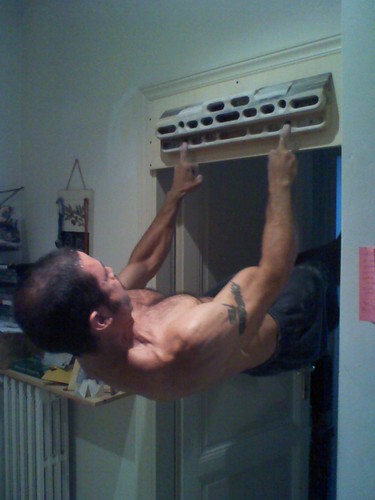 |
| This could be you! But probably not... and don't worry about it anyway |
I think the first myth that needs to go is whether one brand/style/etc. is better than another. The commercial message is definitely something that needs to be cut through here, though I think that manufacturers are sincere enough in trying to provide a good product. The only thing that really matters in a commercial board is avoiding rough textured plastic. Commercial fingerboards are prone to this problem and while the flexibility of molding shapes in plastic is theoretically desirable, the presence of excessive friction interferes with the primary purpose of the board, training your fingers and forearms. It can also discourage use of the board if the texture is painful. This is one thing to be said for the Beastmaker brand of fingerboards, that since they are made of hard sanded wood, the relative absence of friction is a real plus.
This brings me to the next myth, namely that shapes matter. Fingerboards have been made in a wide variety of elaborate, even baroque shapes, with ornate curved edges and sets of pockets, pinches and slopers and so on, shapes that look attractive in a catalog, ad, or website, especially with some swirly colors added in. My experience has been that these shapes provide little or no practical functionality that cannot be readily supplied by other less expensive means. At their worst, they offer shapes that could promote injury rather than progress.
Instead, I would recommend that you consider the possibilities present in a simple single edge made of wood, of first-joint depth with a gentle curved outside edge, approximately 2 feet in length, similar to a typical intermediate-size campus rung. This item will cost perhaps $2-5 and can be easily mounted to a piece of plywood (cost $5-8) if need be, or screwed directly to an exposed beam as in a cellar. You can easily add more edges of greater or lesser width by visiting a local building supplies store, probably even picking up usable pieces of wood for free in the scrap pile.
By the way, the closest "commercial" version of this concept is made by Sonnie Trotter but anyone with some simple tools and a piece of sandpaper could recreate this style very easily on their own. His board however looks very good. Whether he's actually making them right now, I don't know. I can find out.
 |
| Sonnie Trotter's V-Board |
The last myth I want to discuss, which will lead into the next post, is that a fingerboard will actually do much for you by itself. This is unlikely to be the case for a number of reasons. First climbing, while heavily dependent on finger strength, relies very much on the ability of the upper limbs to pull dynamically independently of each other, a skill best improved by either climbing or campusing. Secondly, climbing relies on effective use of body tension and foot placement something that simple hangs on a fingerboard cannot easily develop. Finally, most climbers, because of the points made above, will find it more useful to become more efficient in their time spent climbing, planning their sessions to deliberately squeeze more climbing into them in whatever time is available.
That said, the fingerboard can be, ounce for ounce, one of the most effective training tools out there. In a following post, I will discuss how to get the most from this simple inexpensive versatile apparatus.
Monday, March 12, 2012
Bouldering with Adam Ondra
I just posted an interview with Adam Ondra on Mountains and Water. Please check it out. Here are some of Adam's thoughts on bouldering:
"It seems like you did a lot more bouldering in the past two years than before. Why did you begin to emphasize bouldering and train more specifically for it?
"It seems like you did a lot more bouldering in the past two years than before. Why did you begin to emphasize bouldering and train more specifically for it?
I did it because I love
variety in climbing. One obvious reason why to love bouldering is because of
its purity. I reckoned that it might have helped in sport climbing too, but it
wasn't the main reason. Last autumn I was only bouldering and the main reason
was that I had never really focused on that for longer period of time. I wanted
to find out how hard I could boulder when completely focused on it."
"What does bouldering do for your climbing overall?
I am stronger and that
is why I can do moves on the routes easier. I realized that it is important to
try different beta, because bouldering taught me that even the most
impossible-looking beta might be the easiest solution to the problem."
Tuesday, February 7, 2012
FRCC Bouldering Interview
OK, from an action standpoint, this is not the most exciting bouldering video on the Internet but it gives a good sense of what I wanted to do with my book. I was interviewed about the book at the college where I teach so there is more about the intellectual, artistic and aesthetic aspects of the sport, emphasizing the ways in which this form of climbing can enhance a person's life.Thanks to John Feeley for doing this interview.
Wednesday, January 11, 2012
Interview With Carlo Traversi
Carlo Traversi
Interview
Anyone interested in the contemporary bouldering scene has
heard of Carlo Traversi. His repeat of Jade (V14) in 2010 put him on the map
nationally though a 2008 ground-up ascent of Evilution was certainly an
indication of things to come. In 2011, his second ascent of the Game (V15)
firmly put him in the nation’s roster of elite climbers. Currently residing in
Boulder, Carlo is head route-setter at the Spot Gym. Carlo is also a route
climber with ascents of 5.14s at Rifle as well as a voyage up Ariana, the
classic high-altitude 12a on the Diamond.
 |
| Carlo on Direction V13 Buttermilks |
Carlo reviewed my book for Rock and Ice late last year and
mentioned in that review that the book “lacked the more advanced philosophies
of using momentum that could make it more useful to advanced climbers looking
to join the world of the elite.” Since I see Carlo all the time at the Spot, I
took a few minutes to talk with him about what that meant to him and share with
my readers what he had to say. For me one of the great things about bouldering
is the focus on analysis and self-reflection and learning from both experience
and observation. Since my bouldering is always a work in progress, my thinking
and writing about it is as well.
 |
| Carlo on The Never Ending Story V14 Magic Wood, Switzerland |
Looking over this interview, I hope readers will take away
the central point that better climbing is not necessarily the result of
application of technique or strength training but of better understanding of
one’s own body and its adaptation to the challenges of difficult movement. Attitude and psychology are at least as important as physical strength.
 |
| General Disarray V13 Brione |
December 2011, The Spot Gym
PB: Carlo, (in your review of my book) you said something
along the lines of, there seemed to be another set of principles or ideas,
whether related to movement or training, to get to what might be described as
an elite level of bouldering. Could you describe what you think an elite level
of bouldering is and what those ideas and principles are?
CT: I guess they aren’t really set-in- stone principles at
this point. I would more or less call them theory. The way I see it is that looking
at elite boulderers, they’ve defined their own styles and have excelled in
those styles separately. What has defined the stronger boulderers in the world
is that each has a very definite and distinct style and they have perfected
that style to a certain extent, beyond what anyone else has.
PB: By elite, first of all, you mean what level are we
operating at? V14 and up?
CT: I wouldn’t even necessarily call it a grade thing. I
would categorize those people based on their ability to define their own style
and progress within it, and climb very hard in that way. Obviously, Ty has a
certain style, Daniel has a certain style, Paul has a certain style, Fred
Nicole has a very certain style, Dave has a style, Nalle, Adam Ondra. I would
categorize them as some of the world’s best boulderers and they very much have
their own, when they climb it has certain look, a flow. They have a certain way
of doing things that makes them distinct from one another. They have learned
their body well enough to be able to progress within that style, doing the same
climbs, but in different ways, making it look different. When I felt like I began
to enter into that world is when I started to really understand my own
particular style, apart from anyone else’s. I would think, “Yeah someone else
might have done it this way, but I really need to start just understanding me
and how I interact with rock differently from anyone else.” We’re not going to
do it all the same. I think that kind of understanding pushes you further into
that elite world.
PB: What you seem to be saying is that if you want to get a
lot better as a boulderer, it’s not just applying obvious techniques. That will
only get you so far. It’s that you need to know how you’re going to fit, not
just with the holds, but with the positions and movements between the holds and
even an overall feel for the problem from beginning to end.
CT: It’s very much an awareness of your own body and I’ve
only seen that awareness at a really high level among the people we would consider
to be elite boulderers. They have a very good understanding of how to do things
in their own way. That’s what sets them apart. That’s not something that’s
trained or taught. That’s something that’s learned. It’s learned through
practice and experience and yes you’re applying the same techniques as everyone
else but you start applying them differently and you start deciphering them in
your own ways.
PB: What do you think about the emphasis a lot of boulderers
seem to have on physical training, whether it’s fingerboards or weighted
pull-ups or other things like that?
CT: I think it’s helpful for sure. Your ability to hold onto
small stuff or bad holds can be trained. Your body can be trained that way but
there are people such as Dave Graham who isn’t physically that strong and he
knows it, and he says it all the time, that physically he’s not that strong a
climber. But he does have strong fingers and he knows how to maneuver his body
around holds. Dave doesn’t engage holds, he moves around them almost, from what
I’ve seen. He doesn’t just pull on stuff, he grabs it and negotiates his body
around it. Rather than just pulling onto it head-on. It’s very different and
very much his own thing. I’m not as long as he is. I don’t have as many options
for where to put my feet or where to maneuver my body compared to Dave so I
have to rely more on physical strength because I am a little bit shorter. It
doesn’t make me a better climber or a stronger climber. It just makes my style
different. I think the emphasis on physical training is key but it depends on
your body type. In some ways it helps but it’s not always necessary because
your understanding, specifically of natural rock, is going to be different.
It’s not going to rely as much on training in the gym or training on a
fingerboard because you’re not going to find a wooden rung outside that you
will be campusing on. You going to find holds that you’re going to have to
figure out how to grab the right way and move your body around on.
PB: The thing that I have noticed working on harder and
harder problems, say in the Park, is that although there are small sharp
crimps, there are more often holds that are a little bit sloping or hard to
grab or good to grab in only one position that doesn’t relate well to the classical
kind of grip. If you were going to give someone advice on what seems to me an
intuitive approach, listening to how your body works in a certain situation,
what sorts of things would you recommend people pay attention to if they are
trying to develop a personal style in climbing?
CT: Look at yourself climbing. I have a ton of video of
myself climbing so I can sit back and watch how I do things compared to
everyone else. I was able to see my weaknesses and strengths and further
develop on those things, knowing what I was strong at and develop my style in
that way. I might say, “I can’t do that crazy undercling move by standing up
into it, but if there was a hold above it, I am really good at double clutches
and stuff like that so maybe I can jump to the upper hold and catch the
undercling on the way out.” I start seeing boulder problems from my own
perspective, of what can I actually do on this rather than what I should do
based on other people.
PB: You mentioned the double clutch just now. It seems like
momentum plays a large part in how you climb. How do you make the steps toward
using momentum better in bouldering?
CT: I think it’s kind of letting yourself go a little bit.
It’s a challenge because you let go of techniques that allowed you to get where
you are now. The “pogo” technique per se
is, I have taught a lot of technique classes, you’re pretty much doing the
opposite of what you are initially taught to do. You are taught to reach off a
backstep to do a move statically but with a pogo you’re basically using the
same side leg as your arm and…
PB: It’s like a dynamic barn-door move…
CT: It is, yeah. You have to get to a point where you
understand what good technique is and then what I did is start pogoing stuff
because I couldn’t reach it. I started trying to find ways to use my body to get
there. It was weird because then I there was one comp where the finish move was
a backstep opposition move to the jug and I pogoed it and missed the hold
because I pogoed too far. In retrospect, I should have stuck with the original
technique but I was in the process of learning to pogo and it was very much an
obsession of mine and it was during that time that I did that and didn’t really
understand that now that I know how to do this pogo technique and use momentum,
I need to figure out when is that really useful and when is that just excess
motion. It’s like this timeline of experience. If you learn a certain technique
your style is going to follow that way but you have to slowly bring yourself
back to what you used to do, to good technique, and use it when you need to.
PB: In terms of the future direction of bouldering, kinds of
problems moves etc., where do you see things heading?
CT: It’s going to be people, the elite boulderers of the
world, finding problems in their style and those problems are going to be the
hardest things in the world. Each climber is going to push their limits in
their own way. I need to find stuff that’s slopey compression with
super-dynamic movement. Colorado doesn’t have a lot of that. It tends to be
edges and locking off. Ultimately it’s going to end up in sport routes. It has
to. In bouldering the holds can only get so far apart and the holds can only
get so small for your skin really to be able to hold onto them. Bouldering has
definitely not reached its limit. There are lots of hard things to be done, new
techniques to be learned, but in the long run it is going to be applying those
principles to longer things.
PB: Where do you think Colorado bouldering is headed? There
has been a lot of development in the pat ten years or so. Has the wave crested?
Is there still more out there?
CT: I still think there is plenty to go. I know of several
five-star projects in the Front Range and the Park that are amazing and could
very well be in the V15 range. There aren’t as many strong people here just
developing them as there have been. When you have as many strong people as
there used to be here with Daniel, Paul, Ty and everyone living here, they were
all pushing each other to do it and it was really helpful for everyone. That
doesn’t exist right now so it’s slowed down the development of thereally
high-end stuff but you still have people out at Lincoln Lake opening V7s and
V8s, developing tons of easier stuff. People saw Lincoln Lake as, “Yeah the
rock’s not that good but we can create what we want here,” in many ways
(laughing), some of which I don’t agree with, but an area was created and
people enjoy it and that’s what important. There are plenty of those areas to
be developed in Colorado.
PB: How about the issue of professionalism in the sport?
What’s your feeling on where that’s headed?
CT: I think it’s improving. It’s going to come down to
companies not wanting to work with people unless they have that professional
attitude and interact with the community in a professional manner. It’s slowly
coming to that. With Adidas picking up Five Ten and bigger companies start
moving in and sponsoring athletes, that’s what they expect and they are not
going to settle for anything less. Climbers if they want to get stuff from the
community and be sponsored and be a professional athlete, they are going to
have to fill that role. That’s what going to dictate it and it’s slowly moving
in that direction. It’s hard to tell how fast it’s going to get there because
we have seen companies come in and get out after a few years because they
didn’t think it was lucrative. The biggest thing I have seen recently is Adidas
picking up Five Ten because a purchase like that is pretty serious and can
bring a lot of money to our sport. It’s not like, “Hey we’re going to sponsor
this athlete for a few years and if we don’t like it, we’re just going to back
out.” Instead we’re buying a company that’s climbing-oriented and this company
is going to be a part of us and that’s a much bigger deal than picking up an
athlete.
PB: How about your work with PCI?
CT: It’s good. I think the biggest thing that’s coming out
of that right now is the clinic series we’re running where we’re going around
and teaching a very structured clinic program on technique and how to train
power. We’ve done a couple of them. I’ve done one in Dallas and one in Portland
Oregon now. They’ve been good. People have been really receptive to them,
really psyched. We’ve been trying to run them in the most professional way
possible.
PB: What about future climbing projects and trips?
CT: I’m going to Font in March and maybe Japan in April,
Japan mainly for teaching and clinics and interacting with the scene over
there. Font because it’s Font and I haven’t been there.
PB: Are you going back to Switzerland?
CT: The plan is to go to Europe in March and be there for a
month or so. If the weather turns bad in Font we’ll go to Switzerland for a bit
because it’s not that far. Maybe try some stuff in Swiss. There are some sick
projects there. There is some stuff I definitely want to finish there but I
might want to wait until next fall to go back fully again. I want to make sure
that I am at my peak level.
PB: Any local projects?
CT: There’s the one in the Flatirons, at the PB boulders. I
got really close to that, basically grabbed the finish hold and slipped off. I
don’t think it’s that hard. It’s probably like V12, it’s thin and it hurts, but
it’s probably only V12. And then there’s Nicky’s project, which is in Estes
Park, almost in downtown Estes. It’s probably V14. It’s like Stained Glass,
same quality of rock, with a seam that runs from bottom to top; it’s amazing.
Done all the moves on that, made some really good links. Whenever the weather
calms down I am psyched to get back out there. (This was climbed by Dave Graham
soon after the interview and called Memory is Parallax V14)
PB: Hypnotized Minds?
CT: For me Hypnotized would be great. There’s the roof
project right below Hypnotized. That thing’s amazing, probably V15 as well.
Definitely doable, just really hard. There are a lot of projects, really good
ones. There’s that project left of Jade which I think is phenomenal. Between
1000 Shades of Green and Don’t Get Too Greedy. I tried it with Daniel one day
and we were only able to do one move on it. It’s definitely the next level for
Colorado. It’s awesome, great climbing too.
Thanks Carlo!
Here's an excellent new short film about his climbing this past season
Saturday, January 7, 2012
Deadpoint Magazine Review
Deadpoint Magazine posted a great review of my book on their website. Please take a moment to check it out.
Here's a quote: "The challenge for any author tackling this kind of topic is being able to present massive amounts of potentially stale information in a way that seamlessly incorporates why it is important and why we should keep reading. Beal was able to weave together the hard facts, tactics, and movement of bouldering with the reasons that we want to boulder in the first place. It’s the thoughtful writing style that allows one to continue turning the pages of this comprehensive tome on bouldering, and comprehensive it is."
 Also I was psyched to see that my friend Andrew Kornylak's film A Fine Line was mentioned by National Geographic Adventure. I did a lot of narration in the film (which I really should review) and NGA featured an excerpt "The Vision of Dave Graham" embedded below. Well worth watching, as is the entire film which is available at HDclimbing videos.com.
Here's a quote: "The challenge for any author tackling this kind of topic is being able to present massive amounts of potentially stale information in a way that seamlessly incorporates why it is important and why we should keep reading. Beal was able to weave together the hard facts, tactics, and movement of bouldering with the reasons that we want to boulder in the first place. It’s the thoughtful writing style that allows one to continue turning the pages of this comprehensive tome on bouldering, and comprehensive it is."
Thursday, December 29, 2011

Tuesday, December 13, 2011
Who Should Buy My Book
In a previous post, I wrote a little about the contents of my book on bouldering, letting readers know in advance what I was offering them. In this post, I want to explain a bit more in detail what kind of climber I see as benefiting the most from the book.
When I first started climbing, there were hardly any climbers where I lived, meaning I relied upon books to guide me through the ideas and techniques of climbing. I sensed from early on that there was a gap between what I was actually doing and what the books were talking about, especially in the late 1970s when climbing meant rock climbing with ropes with all the expected emphasis on safety and proper use of gear.
However I realized I was interested mostly in the problems of movement on rock, meaning I was a boulderer long before the sport had very much "respectability" or a separate identity. Until I saw a copy of Master of Rock by Pat Ament, there was very little writing on the subject and certainly not a how-to book. Because of this, I had to learn by trial and error, feeling my way through the learning process. I had to learn especially to ignore the preconceptions and misconceptions of my peers, especially the older ones, brought up in an ethos of risk and rebellion. What I sought was a deeper understanding of what was possible on rock, in terms of movement and technique. I wanted to explore this direction free of the baggage of the past with its distracting ethical debates and squabbles.
This book is offered as a tool for anyone who wants to learn how to climb in an environment free of assumptions or expectations. I have striven to keep an unbiased attitude toward the achievements of past and present alike, only asking that the integrity of the natural world be honored as much as possible.
The book will not be able to do the following:
1. Make you stronger overnight: Throughout I emphasize instead the need for mastering technique instead of strength training.
2. Introduce you to secret climbing or training techniques that the "pros" use: The fact is that most climbing technique is elementary and foundational and the refinements of it only can be worked out in practice.
3.Make you go from V6 to V8: If you are climbing at that level, you probably already know enough to make it happen by yourself. Though I think that if you read it closely, you may find something of value there that could make the difference...
On the other hand, if you want a solid foundation that will serve you well for progressing safely and productively as a climber (not just a boulderer) who will climb for a lifetime, I think my book is the best resource you can begin with. I wrote it with precisely that goal in mind. Because bouldering is such an amazing game, anyone who wants to try it should have the best experience possible, and I feel this book can help in that process.
However I realized I was interested mostly in the problems of movement on rock, meaning I was a boulderer long before the sport had very much "respectability" or a separate identity. Until I saw a copy of Master of Rock by Pat Ament, there was very little writing on the subject and certainly not a how-to book. Because of this, I had to learn by trial and error, feeling my way through the learning process. I had to learn especially to ignore the preconceptions and misconceptions of my peers, especially the older ones, brought up in an ethos of risk and rebellion. What I sought was a deeper understanding of what was possible on rock, in terms of movement and technique. I wanted to explore this direction free of the baggage of the past with its distracting ethical debates and squabbles.
This book is offered as a tool for anyone who wants to learn how to climb in an environment free of assumptions or expectations. I have striven to keep an unbiased attitude toward the achievements of past and present alike, only asking that the integrity of the natural world be honored as much as possible.
The book will not be able to do the following:
1. Make you stronger overnight: Throughout I emphasize instead the need for mastering technique instead of strength training.
2. Introduce you to secret climbing or training techniques that the "pros" use: The fact is that most climbing technique is elementary and foundational and the refinements of it only can be worked out in practice.
3.Make you go from V6 to V8: If you are climbing at that level, you probably already know enough to make it happen by yourself. Though I think that if you read it closely, you may find something of value there that could make the difference...
On the other hand, if you want a solid foundation that will serve you well for progressing safely and productively as a climber (not just a boulderer) who will climb for a lifetime, I think my book is the best resource you can begin with. I wrote it with precisely that goal in mind. Because bouldering is such an amazing game, anyone who wants to try it should have the best experience possible, and I feel this book can help in that process.
Subscribe to:
Posts (Atom)